As many of you likely know, Lutz Roeder turned over control of one of the “must have” .NET developer tools, .NET Reflector to Red Gate software. True to their promise, RedGate has continued to support the free version of Reflector and make continued improvements, including the addition of a Visual Studio plugin to jump into Reflector and the support of .NET 4 assemblies with their most recent release of the tool.
Lightweight, Aspect-Oriented Instrumentation with PostSharp, NLog, and SQLite
How would you like to achieve detailed exception and trace logging, including method timing and correlation all within a lightweight in-memory database that you can easily manage and query, as exhibited below?

All of this requiring nothing more of you than simply decorating your methods with a very simple attribute, as highlighted below.
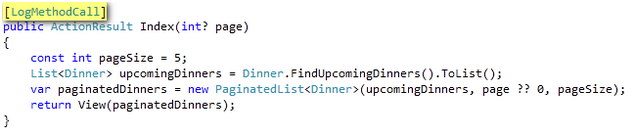
In this post, I’m going to demonstrate how to configure PostSharp, an aspect-oriented framework, along with NLog and SQLite to achieve the benefits highlighted above. Before I get into the details of the configuration and aspect source code, I’ll provide a bit of background on PostSharp.
Watch Out! .NET Web Services and the XML Serializer
Sometimes you know that something works a certain way but you haven’t really internalized it, you haven’t grok’ed it, until you experience it firsthand. Such was my knowledge of the interaction between .NET web services and the XML Serializer a couple of weeks ago.
While troubleshooting calls made from a smart client to back-end web services, I was using Process Monitor to see what was going on under the hood. It didn’t dawn on me at first why I was seeing dynamic generation of temporary C# files and compilation of these files using the C# compiler (csc.exe) as shown in the image below. Since the services in question were provided by a legacy mainframe and were necessarily granular and immutable, the client application was generating a lot of new proxies, meaning a lot of wasted time.
Book Review: Ultra-Fast ASP.NET
I picked up this gem of a book when it first came out in eBook format during the PDC. I sent it over to my Kindle and got through the entire book during session downtimes. I planned on being the first to post a review of this book on Amazon but I’ve sat it out too long and will now be the fifth review.

The first four reviewers did a pretty respectable job of providing and overview of Mr. Kiessig’s qualifications and the book content and have all awarded the book the entirely deserved 5 start rating. Rather than pile on more information about Rick Kiessig or what’s in the book, I’m going to tell you why, as a person who has spent a good amount of time looking at .NET application performance, I recommend this book to every person I work with as mandatory reading:
WCF Concurrency and Instancing
I’ve been ranting to some colleagues about a particularly useful table that showed the interactions between WCF’s InstanceContextMode and ConcurrencyMode behaviors. I referenced it in a conversation again today and decided that I needed to go hunt down the phantom table so that it haunted me no longer.
I thought the table was in Lowy’s Programming WCF Services. Full attribution to Essential Windows Communication Foundation: For .NET Framework 3.5, one of my other favorite WCF books. I’ve copied the table below so that I can refer to it by hyperlink forever more.
Logging to SQLite with NLog
This is one of those seemingly trite blog entries – unless you’re actually trying to integrate System.Data.SQLite with NLog, in which case it’s invaluable. SQLite and NLog really are the perfect combination for lightweight logging. You avoid the sprawl of file-based logs over time, can execute SQL queries against your logs and have an absolutely minimal database footprint to deal with. If only you can get the configuration correct…
The NLog documentation provides some hints to get you going in the right direction for database-based logging. However, no matter how much spelunking I did around the Net, I couldn’t find a definitive answer on how to configure NLog to use SQLite. The configuration file that worked for me can be found below. Exact mileage may vary based upon your project setup. This should get you 95% of the way there though. Happy logging!
