Beckshome.com: Thomas Beck's Blog

Musings about technology and things tangentially related

Keystone Technology Plan Issued

Pennsylvania’s Office of Information Technology (OIT) issued the Keystone Technology Plan to serve as the information technology blueprint through the year 2009. The plan’s phased approach is quite interesting, with the following phases taking center stage:

  • Yesterday: Enterprise Planning and Governance
  • Today :Shared Infrastructure Services
  • Tomorrow: Business Centric Services

BSCoE plays a prominent role in OIT’s vision and is mentioned as a driver of infrastructure today and key player in the creation of business-centric services in the future.


User-Generated Content

For some time I’ve been giving thought to user-generated content on the Internet. In particular, I’ve been interested in audio and video content. A recent post by Dion Hinchcliffe drove me to put a bit more structure around my ideas and put pen to paper, figuratively speaking.

I’ve been following Dion’s blog for nearly a year now and his writing helped shape my thinking about Web 2.0. Although I strongly agree with his statement that user-generated content is one of the pillars of Web 2.0, it appears that we disagree somewhat with respect to the limits of its potential. I can honestly say that user-generated content on sites such as Amazon.com, Wikipedia, and del.icio.us has added tangible value to my online experience. In many ways, there is no way to even emulate these services in the world outside of the Web. I don’t think, however, that I will ever be able to make a similar assertion about video and YouTube, in its current incarnation.


GeoGlue Available

The first, albeit very rudimentary, version of GeoGlue is now available online. As described in previous posts, this release is really nothing more than a soundseeing mashup with Google maps. The functionality is very basic, allowing the user to browse for soundseeing tours graphically using maps and a menu system or to search for tours using a combination of keywords. All tours are provided via MP3 streaming audio, either from the site that created the tour or from GeoGlue.com directly.


e-Government Mashups

Phil Windley’s recent post on e-Government mashups is a great introduction to the topic of citizen-facing Web services. As refreshing as it is to see that progressives in Rhode Island and the District of Columbia are exposing government data to their citizens and opening themselves to the law of unintended consequences, this only scratches the surface of what is possible. As I’m sure Phil knows as a former state CIO, fully open citizen self-service is likely to only go so far. As cool as it is to mashup public highway, crime, and public entity data on a map for the world to see, enabling truly effective government is going to be, to a greater extent, dependent upon empowering government knowledge workers. Imagine if, as an example, a knowledge worker was able to pull together information from their state’s welfare, criminal justice, and revenue (i.e. tax) systems and mash these up in a way that enabled them to uncover hidden relationships between this data and serve the state’s citizens more effectively.


Soundseeing

A couple of weeks ago, I was asked to describe what GeoGlue was. Although, we have a far-reaching strategic vision for GeoGlue, I can describe the functionality in the initial release using two words – “Soundseeing Mashup”. Now both of these words are fairly new additions to the English language. The mashup concept has gained a good deal of traction through all of the Web 2.0 writeups. Soundseeing, on the other hand, was a term that even I had not heard until just a couple of weeks ago.


Open Source Enterprise Applications - Lacking the Critical Mass

I was revisiting an article I penned very optimistically several years ago about open source software collaboratives. Most notably, I mentioned the Avalanche Corporate Technology Cooperative and the Government Open Code Collaborative (GOCC). These were (I stress the “were”) seemingly ill-fated initiatives to share the source code to business applications in the commercial and public sectors, respectively.

Government Open Code Collaborative Avalanche Corporate Technology Cooperative

Open Source Enterprise Applications.pdf (550.16 KB)

Checking on these initiatives two years hence, I discovered that there has been scarce an update to either one of these sites since I wrote the article. Looking back and reflecting on my thoughts and experiences over the past couple of years, I realize that these two initiatives were destined to fail and that the open source community is unlikely to produce quality, open source enterprise applications. Allow me to compare.


Getting Real - The Book

I stumbled onto the book Getting Real: The smarter, faster, easier way to build a successful web application while canceling my Backpack service with 37signals. True to the advice they give in the book, 37signals made canceling their service very easy – one of many valuable nuggets of advice offered in the book.

Getting Real describes the practices, both software development and beyond, used by 37signals, a small company that despite their excellent, easy-to-use applications is perhaps still best known as the innovators and driving force behind the Rails framework. Given the tie to the Rails creators, it is not surprising to learn that this book espouses an Agile approach to software development. What differentiates this book from other Agile texts is that it blends both Agile software development practices with, dare I say it, pragmatic guidance from 37signals and other industry notables on the business of creating, releasing and managing Web applications in the Web 2.0 world. This includes advice on staffing and the organization (borrowing from Peopleware), application design (using a user story / UI approach as opposed to a user story / domain object approach), pricing and signup, promotion strategy, support and post-implementation activities.


BSCoE4J Java Framework

The BSCoE4J Java application development framework was released today to the Commonwealth and is now available for download. The framework contains both abstract and concrete components that support the creation, manipulation, and persistence of domain objects. It interfaces well with, and is meant by no means to supplant, well-understood open source frameworks that address presentation layer, persistence layer, or domain object creation and discovery challenges.

BSCoE4J Java Framework

The addition of the BSCoE4J Framework as the third core BSCoE assets rounds off the BSCoE offering for custom enterprise application development. BSCoE4J joins the BSCoE.NET Framework and the BSCoE Software Engineering Process (SEP), forming a comprehensive set of tools for Commonwealth applications looking to do development in either Java or .NET.


Microsoft .NET Google Map Component

Jacob Reimers’ Google Maps Control has been a genuine blessing for me over the last couple of days. After a lot of prototyping with Google and Yahoo maps, I decided to go with Google maps for GeoGlue and keep Yahoo maps open as an option based upon the development of the APIs as well as any potential licensing or usage constraints. After dealing with the Google APIs directly, and feeling the pain of issues such as the well-known Internet Explorer “Operation Aborted” maps loading issue, I was yearning for an intermediary API that had already thoughtfully addressed some of these issues.


Bose SoundDock

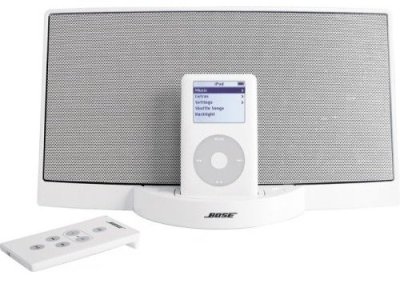
I received the Bose SoundDock as a gift for Father’s Day (thank you girls!) and felt compelled to tell everyone about it. For a couple of days, I mulled over trading in the white model I received for a black model to match my IPod. After reading all the glowing reviews on Amazon.com, I just couldn’t bear waiting another week to try the SoundDock out. I was not disappointed…

Bose SoundDock

The sound on the unit is incredible given its small size. What’s most amazing is that you can crank up the volume and get little or no sound degradation. Given the rather limited controls on the speaker unit, fine tuning is more a matter of tweaking the IPod’s equalizer settings. It gets around pretty well within the house, having made the rounds from the bedroom to the study and ultimately to the basement to accompany me for workouts. From the reviews I read, it would seem that caution (and adequate packing) is advised for transporting the SoundDock over longer distances. I believe that a separate case is available for the SoundDock. If nothing else, you can box it up again and move it around that way.